AI Chatbot vs Rule-Based Chatbot: Which Does Your Business Need?
Short answer: a rule-based chatbot follows a script of buttons, keywords and branches, so it is predictable but breaks on anything unexpected. An AI chatbot reads the question in plain language and answers from your own content, so it handles variety but needs guardrails. Most small businesses do best with a hybrid: fixed rules for sensitive steps, AI for open questions.
Last updated: October 17, 2026. Written by the BossReply Team. BossReply is our product and supports the AI approach, so we also explain where rules still win; we mark anything we could not verify.
Key takeaways
A rule-based chatbot is a decision tree: it only knows the paths you drew. An AI chatbot generates a reply from your content, so it can answer questions you never wrote a rule for.
Rules win when the answer must be exactly the same every time, such as order status steps, consent messages or payment instructions.
AI wins when customers phrase the same question many different ways and your answers live in documents, not in a menu.
The safest setup for most businesses is hybrid: keywords and buttons for fixed flows, an AI agent for open questions, and a human handover for anything sensitive.
What is a rule-based chatbot?
A rule-based chatbot is software that matches what a customer types or taps against rules you wrote, then sends the reply you attached to that rule. If the message contains "price", send the pricing message. If the customer taps "Book a call", start the booking flow.
These bots are often built in a visual flow builder. Each box is a step, each arrow a condition. Because you wrote every path, you know what the bot can say. The cost of that control is coverage: when a customer writes something your rules do not match, the bot falls back to "Sorry, I did not understand" or a menu.
What is an AI chatbot?
An AI chatbot uses a large language model to read the customer's message and write a reply. On its own, a language model knows general things but nothing about your prices, your refund window or your opening hours. So business chatbots pair the model with your own content, usually through a knowledge base. This pattern is called retrieval-augmented generation: the system finds the relevant passages and adds them to the prompt before the model answers. OpenAI's accuracy guide describes retrieval as the fix for cases where the model lacks information, has outdated knowledge or needs proprietary data.
The result feels like talking to a person who has read your handbook. It also introduces a new risk: if the content is missing or the instructions are loose, the model may produce a confident answer that is wrong. We cover that in our guide to stopping an AI chatbot from making things up.
How do they differ day to day?
The difference shows up in five places: how replies are made, how much setup you do, what happens with unexpected questions, how consistent the answers are, and what the cost looks like.
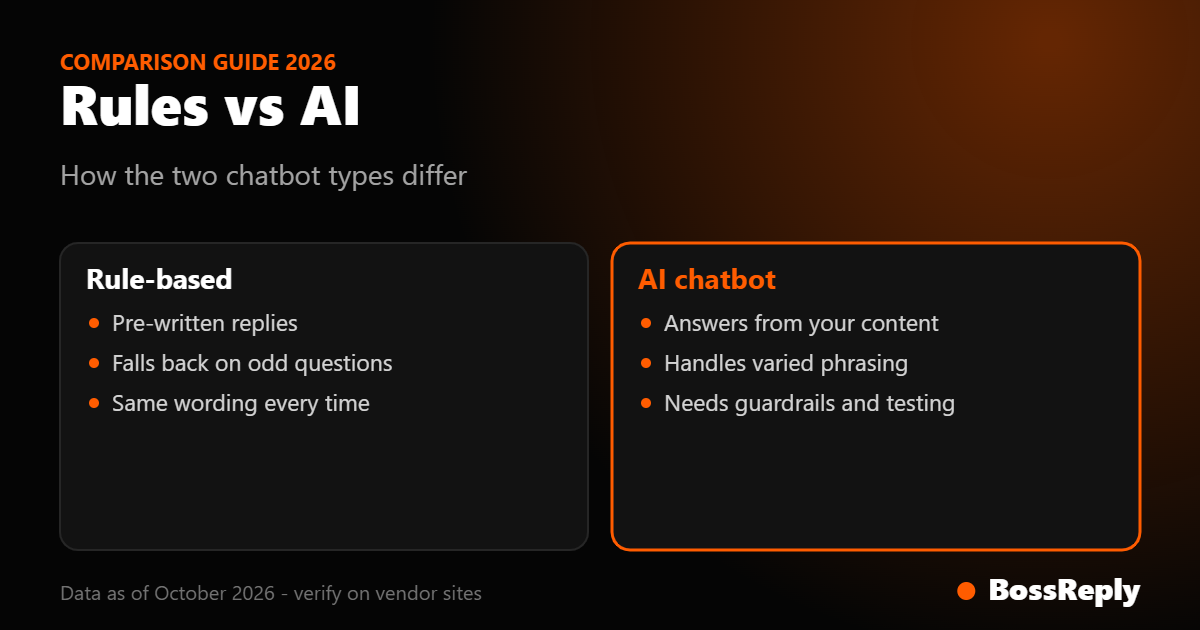
Factor | Rule-based chatbot | AI chatbot |
|---|---|---|
How replies are made | Pre-written text chosen by rules | Generated from your content |
Setup work | Draw every path and write every reply | Add content, write instructions, test |
Unexpected questions | Falls back to a menu or error | Tries to answer; may say it does not know |
Consistency | Identical wording every time | Same meaning, wording varies |
Main risk | Dead ends and frustrated customers | Wrong answers if content or instructions are weak |
Running cost | No model fees | Model usage, or a plan that includes it |
Maintenance | Edit flows when anything changes | Update the content once |
When is a rule-based chatbot the better choice?
Choose rules when the reply has to be exact and the conversation is short. Good examples:
Consent and legal wording. An opt-in message or a disclosure should be the same text every time, not a fresh paraphrase.
Lead capture. Asking for a name, email and budget in a fixed order is a form, and forms do not need a language model.
Keyword triggers. On Instagram, a rule such as "when a comment contains this word, send this DM" is deterministic and fast. BossReply's Instagram comment-to-DM works this way: it catches a keyword in a comment and sends the DM automatically, without posting a public reply.
Menus on very narrow bots. If you only ever answer three questions, a three-button menu is easier to test than an AI.
Rules also have a quiet advantage: they never cost you a wrong answer you did not write yourself. If your business is in a regulated area, or a mistake is expensive, that predictability matters.
When is an AI chatbot the better choice?
Choose AI when customers ask open questions and your answers already exist in writing. Three signs you have outgrown rules:
Your flow chart keeps growing. You add a new branch every time a customer asks something odd, and nobody remembers what the old branches do.
The same question arrives in many forms. "Do you ship to Dubai", "delivery to UAE?" and "can I get it abroad" are one question. A rule needs all three phrasings; an AI model reads the meaning.
Your answers live in documents. If your policies are in a FAQ page, a PDF or a help centre, an AI agent can answer from them without you rebuilding each answer as a flow.
AI also helps with messages that mix topics, such as "I want to change my booking and also ask about parking". A rule tree usually handles one intent at a time.
What does a hybrid chatbot look like?
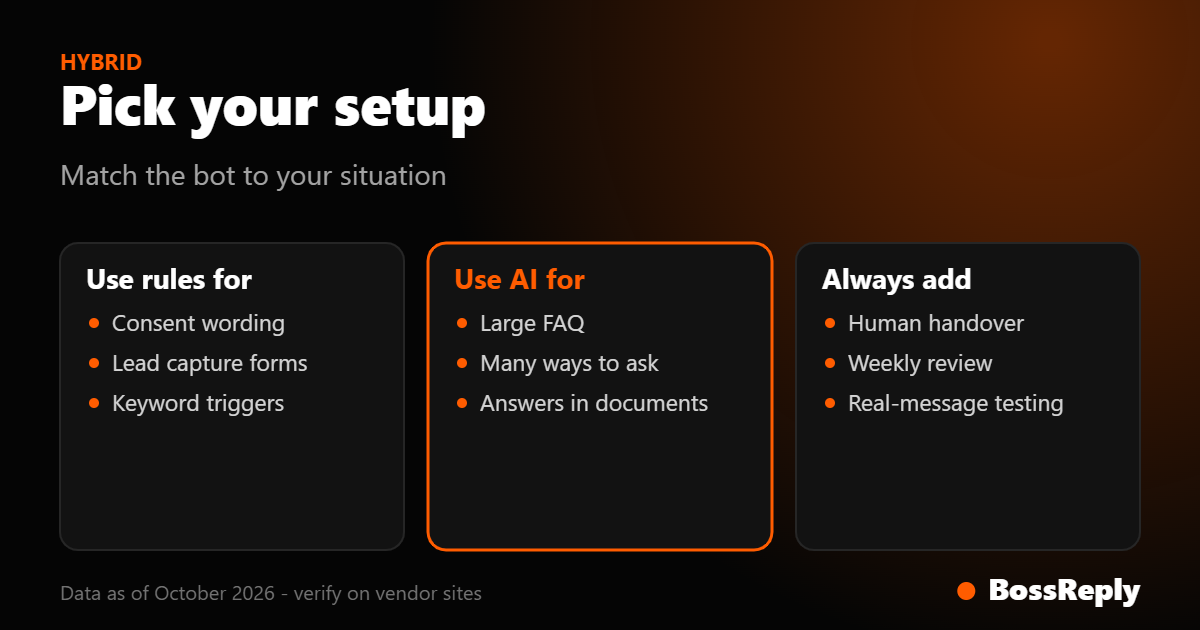
A hybrid chatbot uses rules for the steps that must be fixed and AI for everything else. A practical layout for a small business:
Entry rules. Keywords, buttons and comment triggers start known flows (price list, booking link, opt-in).
AI for open questions. Anything that does not match a rule goes to an AI agent trained on your knowledge base.
Rules for sensitive topics. Refunds, complaints, medical or legal questions go straight to a person, not to the model.
Human handover. When the customer asks for a person, or the AI is unsure, the conversation moves to the shared inbox. See our guide to AI chatbot handover to a human.
BossReply is built around this idea: one inbox for WhatsApp, Instagram, Messenger, Telegram and website chat, an AI agent trained on your own content, and human handover from the shared inbox. You can choose the AI model (OpenAI, Claude, Gemini or Grok) and bring your own API key.
How much does each approach cost?
Rule-based bots have no model fees, but the platform or your time to build and maintain flows costs money. AI chatbots add usage cost for the model. Prices change often, so confirm on each provider's page.
For a sense of scale, the model cost per conversation is small. Using official price pages read in October 2026 and an illustrative conversation of six turns, about 9,000 input tokens and 1,800 output tokens in total, a cheap tier model comes to roughly a fifth of a cent to under one cent per conversation, while a flagship model is several cents. That arithmetic ignores caching and growing history, so treat it as a rough guide. Our monthly cost breakdown shows the full calculation.
The bigger cost difference is often the pricing model of the tool, not the AI. Some tools charge per contact, others per conversation or per seat. See per contact vs per conversation vs flat pricing and our pricing page: BossReply plans are $14, $29 and $69 per month and are not priced by stored contacts.
Which one fits your business?
Your situation | Start with |
|---|---|
Three to five fixed questions, mostly bookings | Rule-based flow |
Instagram giveaways or lead magnets via comments | Keyword rules (comment-to-DM) |
Large FAQ, many ways to ask, documents exist | AI chatbot with a knowledge base |
Regulated topic or high-cost mistakes | Rules plus fast human handover |
Several channels and a small team | Hybrid in one shared inbox |
How do you move from rules to AI safely?
Do not switch everything at once. Follow these steps:
Export your real questions. Collect 50 to 100 recent customer messages. OpenAI's accuracy guide recommends building an evaluation set of 20 or more questions with known correct answers; use your list for that.
Write the content first. Put answers, policies and prices into a knowledge base. If a fact is not written down, the AI cannot use it.
Keep your best rules. Leave opt-in, lead capture and keyword flows as they are.
Test before going live. Ask your 20 test questions and read every answer. Record misses and fix the content, not just the prompt.
Turn on handover. Make sure a person receives anything the AI cannot answer.
Review weekly. Read a sample of real conversations and add missing answers.
What mistakes should you avoid?
Replacing rules that work. A good keyword flow does not need AI.
Launching AI without content. A model with no knowledge base will guess.
Hiding the bot. Some laws and platform rules expect you to tell people they are talking to automation; see the handover guide for details.
Skipping the human option. Customers who cannot reach a person leave.
Judging by one demo. Test with messy, real messages including typos and mixed languages.
Frequently asked questions
What is the difference between an AI chatbot and a rule-based chatbot?
A rule-based chatbot picks pre-written replies using keywords and buttons. An AI chatbot generates a reply from your content, so it can handle questions you did not plan for.
Is a rule-based chatbot cheaper than an AI chatbot?
It has no model usage fees, but you spend time building and updating flows. AI chatbots add model costs, which are often a few cents per conversation or less with cheaper models.
Can an AI chatbot give wrong answers?
Yes. A model can produce a confident but incorrect reply, especially when your content does not cover the question. Anthropic's guidance says its techniques reduce hallucinations but do not eliminate them.
Do I still need rules if I use AI?
Often yes. Rules are better for consent messages, lead forms and keyword triggers where the wording must be fixed.
Which is easier to set up?
A small rule flow is quick. For a large FAQ, adding your documents to a knowledge base is usually faster than drawing a flow for every question.
Does an AI chatbot learn from customers automatically?
Not by itself in most business tools. It answers from the content you provide, so you improve it by updating the knowledge base after reading real conversations.
Can I use both on WhatsApp and Instagram?
Yes. In BossReply the same inbox covers WhatsApp, Instagram, Messenger, Telegram and website chat, and Instagram comment-to-DM can sit alongside the AI agent.
Is an AI chatbot allowed on WhatsApp?
Businesses can use AI to serve customers. WhatsApp's January 2026 terms target general-purpose AI assistants offered as the main product, according to press reports citing Meta; we did not verify the exact wording, so read the current WhatsApp Business terms.
Sources and method
We compared how each approach is built, tested and priced. Pages used, read in October 2026: OpenAI, "Optimizing LLM accuracy" (developers.openai.com/api/docs/guides/optimizing-llm-accuracy) for retrieval and evaluation advice; Anthropic, "Reduce hallucinations" (platform.claude.com/docs/en/test-and-evaluate/strengthen-guardrails/reduce-hallucinations) for the statement that mitigation does not eliminate errors; model price pages from OpenAI, Anthropic, Google and xAI for the cost scale; bossreply.com/pricing for plan prices. The WhatsApp terms point comes from press coverage (TechCrunch, October 2025) and we did not read Meta's current terms text. The cost arithmetic is ours and assumes no caching.
Conclusion
Rules give you control, AI gives you coverage, and most businesses need both. Keep fixed flows for the steps that must not change, put your knowledge into an AI agent for the rest, and make sure a person can step in. Test with real customer messages before you go live.
Want to try the hybrid setup? Get started with BossReply.