Chatbot Pricing Models Explained: Per Contact vs Per Conversation vs Flat
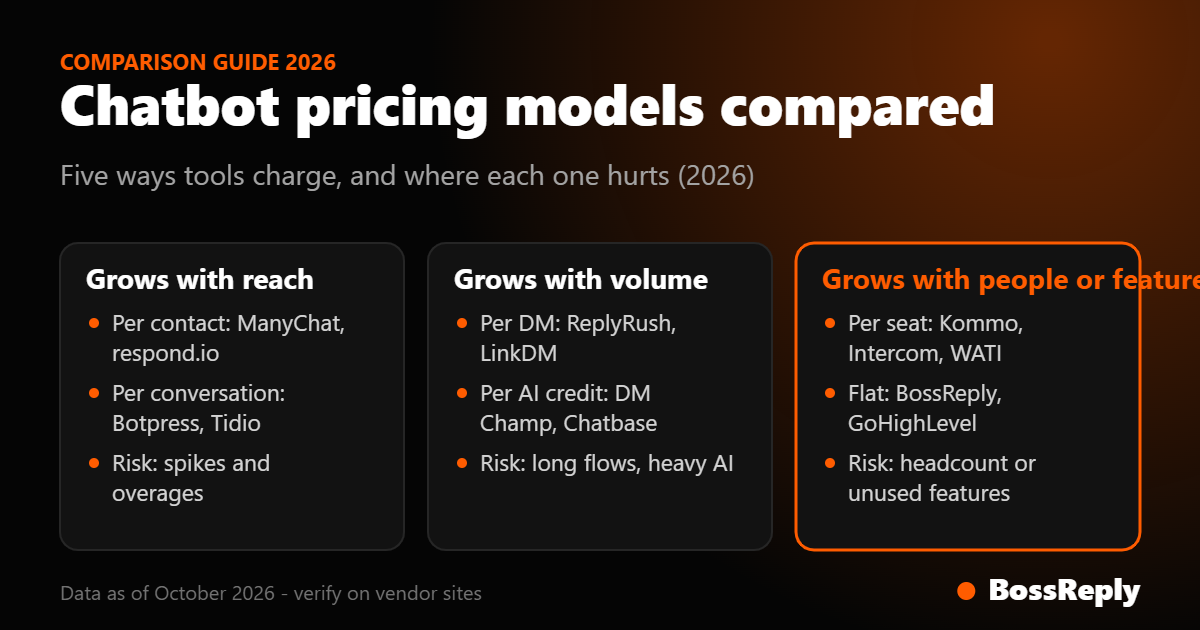
Short answer: chatbot tools bill in five main ways: per active contact (ManyChat, respond.io), per conversation (Botpress), per seat (WATI, Kommo, Intercom), per message or AI credit (Chatbase, DM Champ, Chatfuel, ReplyRush) and flat plans with limits on features (BossReply, GoHighLevel). The cheapest model depends on your audience size, how spiky your traffic is and how much AI you use. Convert every plan into your own monthly numbers before you compare.
Last updated: October 17, 2026. Written by the BossReply Team. BossReply uses flat plans, so we have a stake in this comparison. We show the arithmetic and label third-party data.
Key takeaways
Every pricing model counts something different. A "contact", a "conversation", a "message" and an "AI credit" are not interchangeable.
Per-contact pricing grows with reach, per-seat pricing grows with headcount, and per-message pricing grows with flow length.
Meta's WhatsApp fees are charged separately from every model. AI usage may be extra as well.
The honest way to compare is to write down your monthly contacts, conversations, messages, agents and AI replies, then price each plan against them.
The five pricing models
1. Per active contact
You pay for the people who interact with you in a month. ManyChat and respond.io use this model. A third-party guide edited September 28, 2026 reports ManyChat at $14 for 250 contacts, $29 for 2,500, $69 for 7,500 and $139 for 25,000 on annual-equivalent pricing, with overage fees per extra contact. respond.io lists Starter at $79, Growth at $159 and Advanced at $279, with overage of $12 to $15 per 100 contacts. The model rewards small audiences and punishes spikes.
2. Per conversation
You pay for sessions. Botpress counts a conversation once a person has sent at least two messages in the month. Plus costs $150 per month with 250 conversations and extra packs of 100 cost $65, plus AI usage billed at provider prices. Tidio and Landbot also count conversations or chats. The model suits support teams with predictable ticket volume.
3. Per seat
You pay for each person who logs in. Kommo charges $25 to $45 per user per month with a 6-month minimum. Intercom charges $29 to $132 per seat and Fin costs $0.99 per resolution. Freshchat charges $19 to $79 per agent. WATI includes 3 to 5 users and charges $24 or $69 per extra user. The model suits teams where contacts are many but agents are few, and it hurts as the team grows.
4. Per message, DM or AI credit
You pay for volume sent or for AI work. ReplyRush limits plans by monthly DMs: $10 for 7,500 and $25 for 40,000. LinkDM is reported at $19 for 25,000 DMs. Chatbase sells message credits: $32 for 700, $120 for 4,000 and $400 for 15,000. DM Champ sells AI credits at $0.10 each beyond the included amount, with roughly two replies per credit. Chatfuel includes a dollar AI credit with each plan. Twilio charges $0.005 per message and Gupshup $0.001. The model rewards short flows and punishes long ones.
5. Flat plans with feature limits
You pay a fixed monthly price and the limits fall on features such as workspaces, channels, agents or conversations. BossReply's plans are $14, $29 and $69 per month. Starter includes 500 bot-driven conversations and Pro and Agency are unlimited. GoHighLevel charges $97, $297 or $497 per agency with sub-accounts and usage billed separately for AI. The model gives predictable bills and can feel expensive if you use few features.
Pricing models at a glance
Model | Examples | You pay for | Best for | Risk |
|---|---|---|---|---|
Per contact | ManyChat, respond.io | Active people | Small, steady audiences | Spikes and overages |
Per conversation | Botpress, Tidio, Landbot | Sessions | Support with steady tickets | Seasonal peaks |
Per seat | Kommo, Intercom, Freshchat, WATI | Agents | Few agents, many customers | Headcount growth |
Per message or credit | ReplyRush, Chatbase, DM Champ, Twilio | Volume or AI work | Short, simple flows | Long flows, heavy AI |
Flat with limits | BossReply, GoHighLevel | Features | Predictable budgets | Paying for unused features |
Worked example: 3,000 customers, 4,000 DMs, 3 agents
Suppose a coaching business has 3,000 people who message or comment in a month, a flow that sends about 1.3 DMs per person (4,000 DMs), 1,500 AI conversations and 3 team members. Using the published figures above:
Per contact (ManyChat): 3,000 contacts exceeds Pro's 2,500, so Pro plus 500 extra contacts at $0.05 is about $54, while Business at $69 covers 7,500. The cheaper choice is Pro with overage.
Per DM (ReplyRush): 4,000 DMs fits the $10 Lite plan with 7,500 DMs, but it does not include a team inbox or WhatsApp.
Per seat (Kommo): 3 users on the base plan cost $75 per month, with a 6-month minimum.
Per conversation (Botpress): 1,500 conversations on Plus costs $150 plus 1,250 extra at $0.65, about $962, which shows how conversation-based pricing scales for chat volume.
Flat (BossReply): Pro at $29 covers 3 workspaces, 5 agents and unlimited conversations; AI cost depends on the model you choose.
The numbers differ by an order of magnitude, which is why your own counts matter more than any headline price. These examples exclude WhatsApp fees, AI usage and add-ons.
What happens in a viral month?
Repeat the example with traffic that triples to 9,000 customers and 12,000 DMs while the team stays at three people.
Per contact (ManyChat): 9,000 contacts exceeds Business's 7,500, so Business plus 1,500 extra at $0.025 is about $107, or Advanced at $139 covers 25,000. The bill roughly doubles.
Per DM (ReplyRush): 12,000 DMs moves you from Lite to the $25 Boost plan with 40,000 DMs. The bill rises by $15.
Per seat (Kommo): the bill does not change, because the team did not change, and the extra messages cost only the WhatsApp fees.
Per conversation (Botpress): every extra conversation costs $0.65 on Plus, so the bill can multiply.
Flat (BossReply): Pro stays at $29 within its limits, with unlimited conversations, while AI usage grows with the model you choose.
The lesson is that every model is cheap in some situations and costly in others. Choose the one whose weak spot is least likely to describe your business.
Which business suits which model?
Creators with unpredictable reach: avoid per-contact and per-conversation models unless overage rates are low and capped. Prefer per-DM or flat plans.
Support teams with steady tickets: per-seat or per-conversation plans give a clear link between cost and workload.
Agencies: flat plans with many workspaces keep margins predictable, provided the AI cost can be passed through.
Shops with seasonal peaks: check the overage rules and consider a plan with unlimited conversations.
What about AI costs?
AI can be bundled, billed as credits or paid directly with your own key. Using published provider prices, a six-turn conversation costs about $0.002 on a low-cost model such as gpt-6-luna or Haiku 5.5 and $0.036 on a mid-range model. At 1,500 conversations that is about $3 or $54. A plan that bundles AI at a fixed price can be cheaper or more expensive than that, depending on how many replies it covers. Read our guide to BYOK platforms and our model comparison.
What do WhatsApp fees add?
Meta charges per delivered template message on the official WhatsApp Business Platform, with rates by category and country. Marketing templates are always charged, utility templates are charged outside an open service window, and authentication templates are charged. Vendors have announced that replies inside the window become billable from October 1, 2026, with 1,000 free per month per number, which we could not confirm on Meta's page. These fees sit on top of every pricing model above.
How do you choose a model?
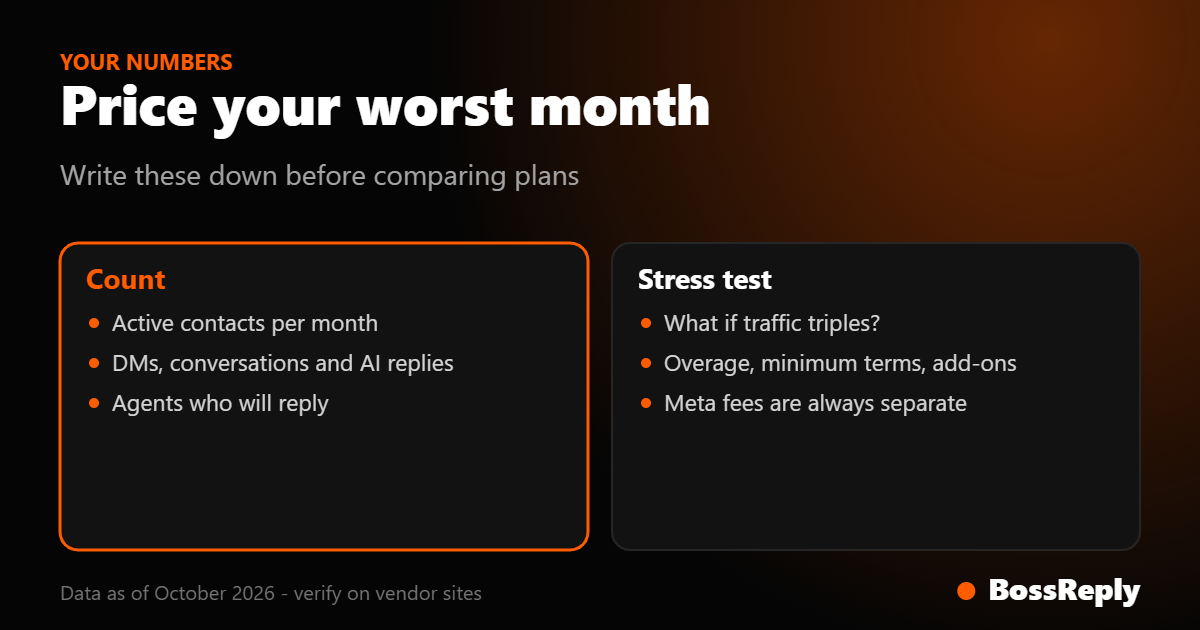
Write down monthly active contacts, conversations, DMs, agents and expected AI replies.
Estimate a spike: what happens if a post goes viral and volume triples.
Price two or three plans against those numbers, including overage and add-ons.
Check minimum terms, cancellation and data export.
Choose the plan whose worst month you can afford.
Common pricing traps
Comparing entry prices instead of prices at your volume.
Ignoring the definition of a contact, conversation or credit.
Forgetting add-ons such as AI, WhatsApp numbers, extra seats or branding removal.
Signing a 6 or 12-month minimum before testing real traffic.
Frequently asked questions
What is the cheapest chatbot pricing model?
It depends on your numbers. Per-contact is cheap for small audiences, per-DM for short flows and flat plans for predictable use.
What is an active contact?
Typically anyone you exchange a message with during the billing month, though definitions differ by vendor.
Are per-seat chatbots expensive?
They are inexpensive for very small teams and costly as headcount grows.
Is flat pricing better?
It is more predictable. Whether it is cheaper depends on which limits you hit.
Do WhatsApp fees depend on the chatbot?
No. Meta charges them separately for the official API.
Do prices change?
Yes. Confirm each price on the vendor's website.
Sources and method
Official pricing pages: botpress.com, respond.io, kommo.com, intercom.com, freshworks.com, wati.io, replyrush.com, chatbase.co, dmchamp.com, twilio.com, gupshup.ai, gohighlevel.com and bossreply.com. ManyChat and LinkDM figures come from third-party guides. Meta: developers.facebook.com/docs/whatsapp/pricing. The worked example is our arithmetic from the prices quoted. Prices were read on October 16 and 17, 2026.
Conclusion
No pricing model is universally best. Count your own contacts, messages, agents and AI replies, then price the worst month. Try BossReply for flat plans, or read the ManyChat pricing explained guide.