OpenAI vs Claude vs Gemini vs Grok for Support Chatbots (2026): Cost per Conversation
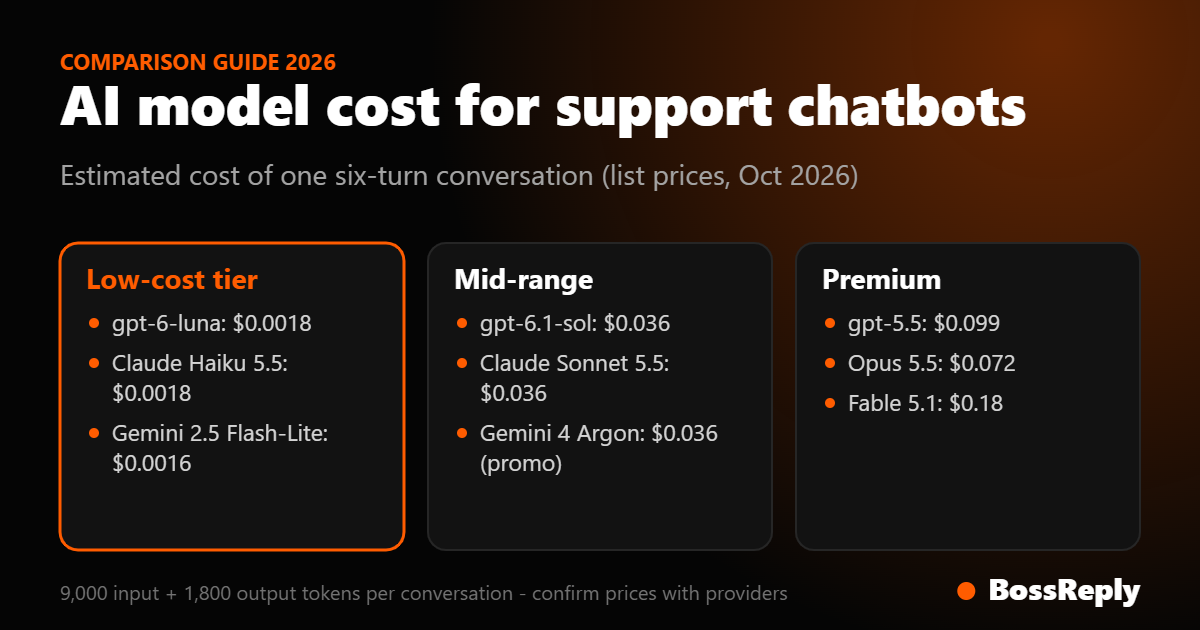
Short answer: for customer support chatbots, the price gap between model tiers is far bigger than the quality gap on simple questions. On published list prices as of October 2026, a six-turn support conversation costs about $0.002 on the low-cost tier (OpenAI gpt-6-luna, Anthropic Haiku 5.5, Gemini 2.5 Flash-Lite), around $0.03 to $0.04 on mid-range models (gpt-6.1-sol, Claude Sonnet 5.5, Gemini 4 Argon) and $0.07 to $0.18 on flagship models. Start with a low-cost model, test on your own transcripts, and move up only where answers fail.
Last updated: October 17, 2026. Written by the BossReply Team. BossReply lets you choose between these providers, so we have no reason to favour one. Prices are provider list prices and quality statements are our opinion, marked as such.
Key takeaways
Cost per conversation ranges from under a fifth of a cent to about 18 cents depending on the model tier, a spread of roughly 100 times.
For FAQ-style support, where the answer sits in your knowledge base, a low-cost model is usually enough. This is our opinion, so verify it on your own conversations.
Prices, model names and promotional rates change often. Gemini 4 Argon's listed rate is valid only through November 30, 2026.
Choose a platform that lets you switch models and use your own key, so you can move as prices and quality change.
How we estimate the cost of a support conversation
We assume a six-turn conversation. Each turn sends about 1,500 input tokens (your instructions, retrieved knowledge-base text and the customer message) and receives about 300 output tokens. That totals 9,000 input tokens and 1,800 output tokens. The cost is 0.009 times the input price per million tokens plus 0.0018 times the output price per million tokens. The estimate ignores prompt caching, reasoning-token overhead and growing conversation history, so real costs are usually higher. Use it to compare models, not to forecast your bill exactly.
Model prices and cost per conversation
Provider | Model | Input / output per 1M tokens | Cost per conversation |
|---|---|---|---|
OpenAI | gpt-6-luna | $0.10 / $0.50 | $0.0018 |
OpenAI | gpt-6.1-sol | $2 / $10 | $0.036 |
OpenAI | gpt-5.5 | $5 / $30 | $0.099 |
Anthropic | Claude Haiku 5.5 | $0.10 / $0.50 | $0.0018 |
Anthropic | Claude Sonnet 5.5 | $2 / $10 | $0.036 |
Anthropic | Claude Opus 5.5 | $4 / $20 | $0.072 |
Anthropic | Claude Fable 5.1 | $10 / $50 | $0.18 |
Gemini 2.5 Flash-Lite | $0.10 / $0.40 | $0.0016 | |
Gemini 3.5 Flash-Lite | $0.30 / $2.50 | $0.0072 | |
Gemini 4 Argon (promo to Nov 30, 2026) | $2 / $10 | $0.036 | |
Gemini 3.1 Pro | $2 / $12 | $0.040 | |
xAI | grok-build-0.1 | $1 / $2 | $0.0126 |
xAI | grok-4.3 | $1.25 / $2.50 | $0.0158 |
xAI | grok-4.7 | $2 / $6 | $0.0288 |
What do 1,000 conversations a month cost?
Low-cost tier (gpt-6-luna, Haiku 5.5, Gemini 2.5 Flash-Lite): about $1.60 to $1.80.
Mid-range (gpt-6.1-sol, Sonnet 5.5, Gemini 4 Argon): about $36.
Premium (gpt-5.5, Opus 5.5, Fable 5.1): about $72 to $180.
xAI: about $13 to $29 depending on the model.
For a small business with a few hundred conversations a month, the AI cost on a low-cost model is a few dollars, so the subscription matters more than the model bill. For a business with tens of thousands of conversations, the model choice can decide the budget.
What does the estimate leave out?
Real bills differ from the table for several reasons, and it helps to know them before you budget.
Growing history: each turn usually re-sends earlier messages, so input tokens grow with conversation length. A ten-turn conversation costs more than twice a five-turn one.
Long knowledge-base excerpts: if your retrieval adds 3,000 tokens per turn instead of 1,000, input cost triples.
Reasoning tokens: some models spend extra output tokens thinking, which raises cost.
Caching: a fixed system prompt can be cached at a lower price with some providers, which lowers input cost. Anthropic's page lists a much cheaper rate for cache hits on Haiku 5.5.
Retries and tool calls: bookings, lookups and escalations add extra model calls.
As a rule of thumb, double the table's figure for a safety margin until you have a month of real usage.
How can you lower AI cost without hurting quality?
Keep the system prompt short and specific.
Retrieve only the two or three most relevant knowledge-base passages instead of pasting everything.
Use a low-cost model by default and escalate only unusual questions.
Cap conversation length and hand over to a person after a set number of turns.
Review the most expensive conversations each week and fix the causes.
OpenAI for support chatbots
OpenAI's list shows a wide range, from the low-cost gpt-6-luna to flagship models. The $2 and $10 tier (gpt-6.1-sol) sits in the middle. OpenAI is the most commonly supported provider across chatbot platforms, which makes it the easiest to connect with your own key. Note that an official pricing page was not reachable by our automated fetch for one OpenAI URL, so we used OpenAI's developer documentation page and recommend confirming the numbers live.
Claude for support chatbots
Anthropic's lineup runs from Haiku 5.5 at the low end to Fable 5.1 at the top. Haiku 5.5 matches gpt-6-luna on price for prompts up to 100,000 tokens, and a cached prompt can cut input costs further for a fixed system prompt. In our opinion, Claude models tend to follow long instructions closely, which helps with tone and boundaries, but we have not run a controlled test for this article, so treat that as a hypothesis to check.
Gemini for support chatbots
Google lists the cheapest per-conversation cost among the models we checked, with Gemini 2.5 Flash-Lite at about $0.0016. Gemini 4 Argon is priced at $2 and $10 through November 30, 2026, and Google notes that rates for several models rise after the promotional dates, so check the page before you commit to a model for the long term.
Grok for support chatbots
xAI's listed models are priced between $1 and $2 per million input tokens, with no sub-$1 input option on the page we read. That makes Grok less compelling for very high-volume support on price alone, though it may suit use cases that benefit from its strengths. Test on your own data.
How do you pick a model for support?
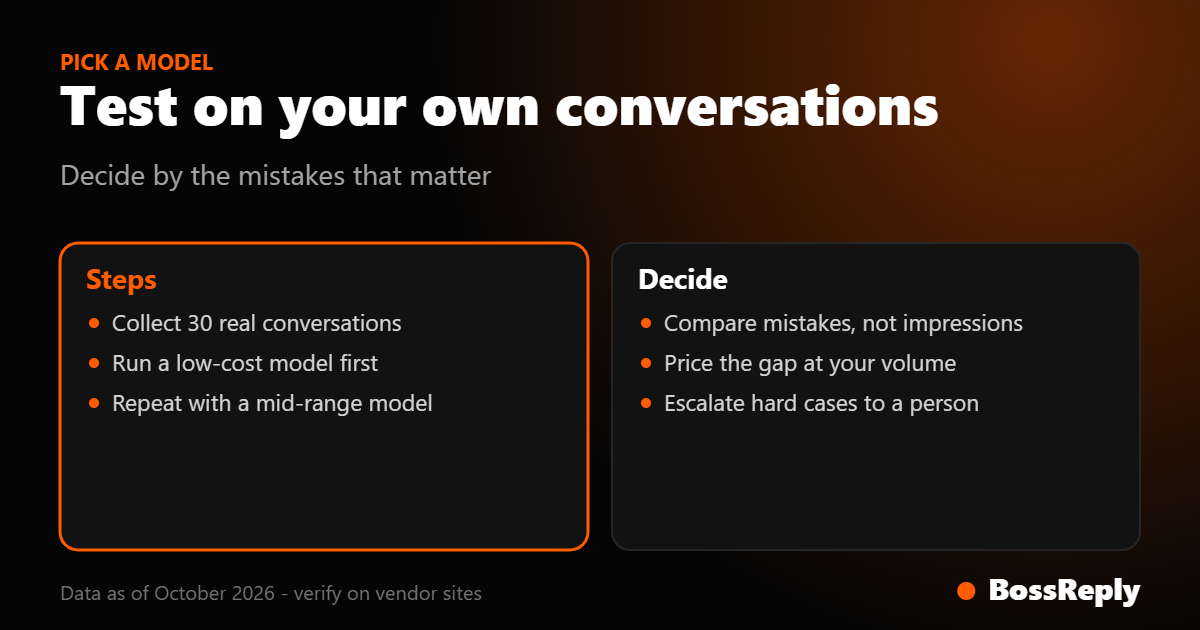
Collect 30 real conversations from your inbox, including hard ones.
Run them through a low-cost model with your knowledge base and mark wrong or off-tone answers.
Repeat with a mid-range model and compare the number of mistakes.
Calculate the cost difference at your monthly volume.
Decide by the mistakes that matter, such as wrong prices, wrong policies or rude tone, not by general impressions.
When is a premium model worth it?
A premium model can be worth the cost when conversations are long, products are complex, or wrong answers are expensive, for example in sales qualification for a high-ticket service. For routine questions about hours, shipping or booking, the price gap rarely pays back. Many teams route simple questions to a low-cost model and escalate hard ones to a person rather than to a more expensive model.
What about languages and tone?
Support chatbots often serve customers in more than one language. All four providers advertise multilingual ability, but quality varies by language, dialect and topic, and we did not run a language test for this article. If you serve customers in Arabic, Spanish or another language, test the same twenty questions in that language on two or three models, including colloquial phrasing, before you choose. Check tone as well: a model that is accurate but curt may need a clearer instruction about how your brand speaks.
Does the platform matter?
Yes. A platform that locks you into one model forces you to accept its markup and its upgrade schedule. BossReply lets you choose between OpenAI, Claude, Gemini and Grok, and bring your own key so you pay your provider directly. Read our guide to AI chatbot platforms with BYOK for the platforms that support it.
Frequently asked questions
Which AI model is best for customer support?
There is no single best model. A low-cost model is usually enough for FAQ-style questions, and a mid-range model helps with longer, more complex conversations. Test on your own transcripts.
Which is cheapest, OpenAI, Claude, Gemini or Grok?
On list prices, Gemini 2.5 Flash-Lite, gpt-6-luna and Haiku 5.5 are all under two-tenths of a cent per estimated conversation.
How much does an AI support reply cost?
A whole six-turn conversation costs from about $0.002 to $0.18, depending on the model tier.
Can I switch models later?
If the platform allows it. BossReply lets you choose the model and change it without rebuilding your bot.
Is a cheaper model less accurate?
Sometimes. When answers come from your knowledge base, the gap is often small, but test your own questions.
Do model prices change?
Yes, often. Confirm prices on each provider's site.
Sources and method
Prices come from provider documentation read on October 17, 2026: OpenAI developer pricing docs, Anthropic's platform pricing docs, Google's Gemini API pricing page and xAI's model documentation. Conversation costs are our arithmetic from the stated token assumptions. Statements about quality are opinion and are marked as such. Third-party sites list different, older model lineups, so check the provider pages.
Conclusion
Treat the model as a setting, not a commitment. Start cheap, measure mistakes on your own conversations, and pay for a stronger model only where it earns its cost. Try BossReply to compare models on your own questions, or visit the BossReply homepage.