How to Start a Chatbot Agency: Pricing, Tools and First Clients
Short answer: to start a chatbot agency, pick one niche, choose a tool that lets you run many client accounts at a fixed cost, build one demo bot, and sell a clear package of setup plus monthly management. Tool costs range from about $69 to $497 per month depending on the platform. The prices you charge are your decision; the figures below are our suggestions, not market statistics.
Last updated: October 17, 2026. Written by the BossReply Team. BossReply is our product and is one of the tools discussed; we label our own suggestions and what we could not verify.
Key takeaways
A chatbot agency sells outcomes (faster replies, more booked calls, fewer repeat questions), not software. Pick one niche so your demo and your offer are specific.
Your tool choice sets your margin: compare fixed platform fees, per-client costs, AI model usage and WhatsApp message fees before you quote anyone.
"White label" can mean anything from hiding a logo to a full reseller portal. Ask exactly what you get before building your brand on it.
Your first clients usually come from people you already reach: a niche you know, a live demo, and a small paid pilot rather than a big proposal.
What does a chatbot agency actually sell?
A chatbot agency builds and runs automated replies for other businesses on channels like Instagram, WhatsApp and website chat. The deliverable is a working assistant trained on the client's own content, connected to their channels, with a person ready to take over.
The typical service list is:
Setup: gather the client's FAQs, prices and policies; build the knowledge base; connect channels; test.
Automations: for example an Instagram keyword that sends a guide or booking link by DM.
Handover rules: when the bot passes the conversation to a person, and who that person is.
Monthly management: reading conversations, fixing wrong answers, updating content.
Because the tools do the heavy lifting, what clients pay for is your judgment: what to automate, what to leave to humans, and keeping answers accurate over time.
Which niche should you pick first?
Pick a niche where enquiries are repetitive and the owner already feels the pain of slow replies. Good candidates are service businesses that get the same questions all day, such as coaches, studios, salons, clinics and local shops. We have detailed guides for coaches and a wider overview in our guide for coaches, course creators and agencies.
A niche helps in three ways: your demo can use realistic questions, your knowledge base templates are reusable, and your outreach sounds relevant. This is our recommendation, not a statistic about which niches pay best.
What tools do you need, and what do they cost?
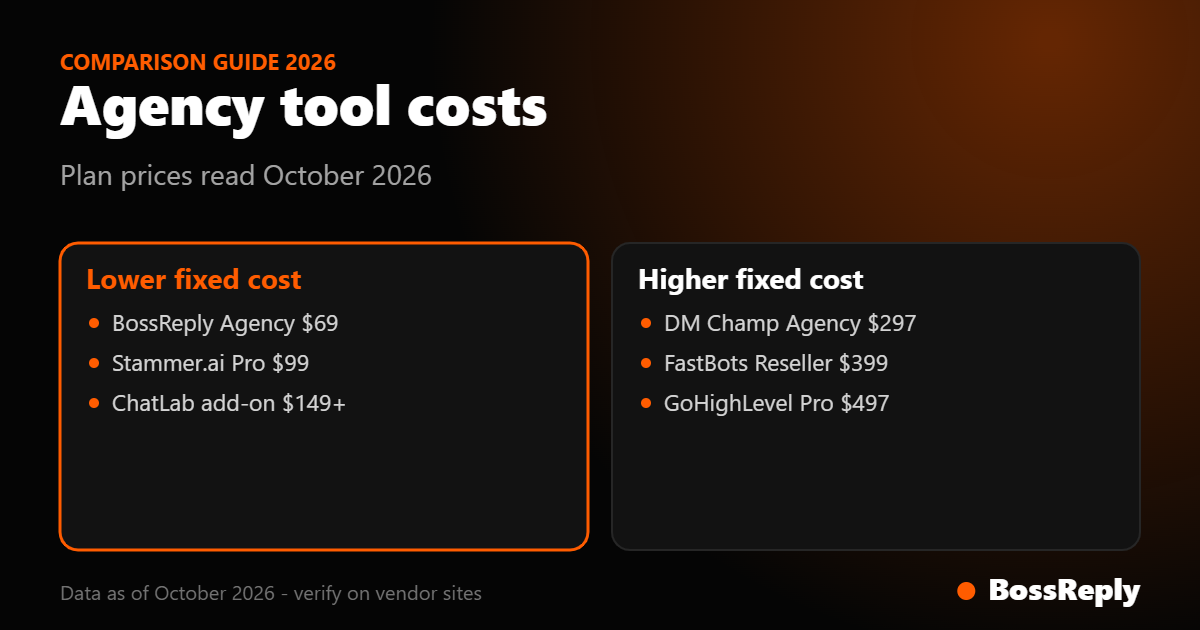
You need a chatbot platform that handles multiple client accounts, plus an AI model key or credits, plus a way to bill clients. Platform fees below come from the vendors' own pricing pages as we recorded them on October 17, 2026; confirm on the live pages because they change.
Platform | Plan relevant to agencies | Monthly price | What we could confirm |
|---|---|---|---|
BossReply | Agency | $69 | Unlimited workspaces, widgets and integrations, 50 chat agents; we make no white-label branding claim |
Stammer.ai | Pro White Label | $99 | Own domain, logo and colours; resell AI usage; 5 chat agents |
GoHighLevel | Agency Pro (SaaS Mode) | $497 | Sell subscriptions, auto sub-accounts, rebilling with markup |
FastBots | Reseller | $399 | 30 bots, up to 5 brands, custom domain |
DM Champ | Agency | $297 | 10 client accounts then $27 each, white label |
ChatLab | Agency add-on | $149 on Scale, $199 on Grow | Client portal on your domain |
For a fuller comparison, read best white-label chatbot platforms for agencies. The BossReply Agency plan is $69 per month, and there is a page for agencies. Because we sell it, weigh our description against the competitors' own pages.
How do AI model costs affect your margin?
If your tool lets you bring your own API key, you pay the model provider directly, and cost depends on the model you choose. Using the providers' published prices recorded in October 2026 and a rough assumption of six turns of 1,500 input tokens and 300 output tokens each, a conversation costs roughly:
about $0.002 on small models such as Claude Haiku 5.5 ($0.10 input and $0.50 output per million tokens) or OpenAI's gpt-6-luna at the same listed rates;
about $0.036 on mid-tier models such as Claude Sonnet 5.5 or Gemini 4 Argon ($2 input, $10 output per million);
about $0.18 on a flagship such as Claude Fable 5.1 ($10 input, $50 output).
That is arithmetic on list prices; real conversations include growing history and sometimes extra reasoning tokens, so treat it as a floor. For FAQ-style support from a knowledge base, we think a small model is often enough, but test on the client's real questions. Our model comparison covers this in detail.
Also budget for WhatsApp. Meta charges per delivered template message (rates vary by category and country), while non-template replies inside the 24-hour customer service window are free, per Meta's pricing documentation. Decide whether you or the client holds the Meta account and pays those fees, and put it in writing.
How do you set up your first client?
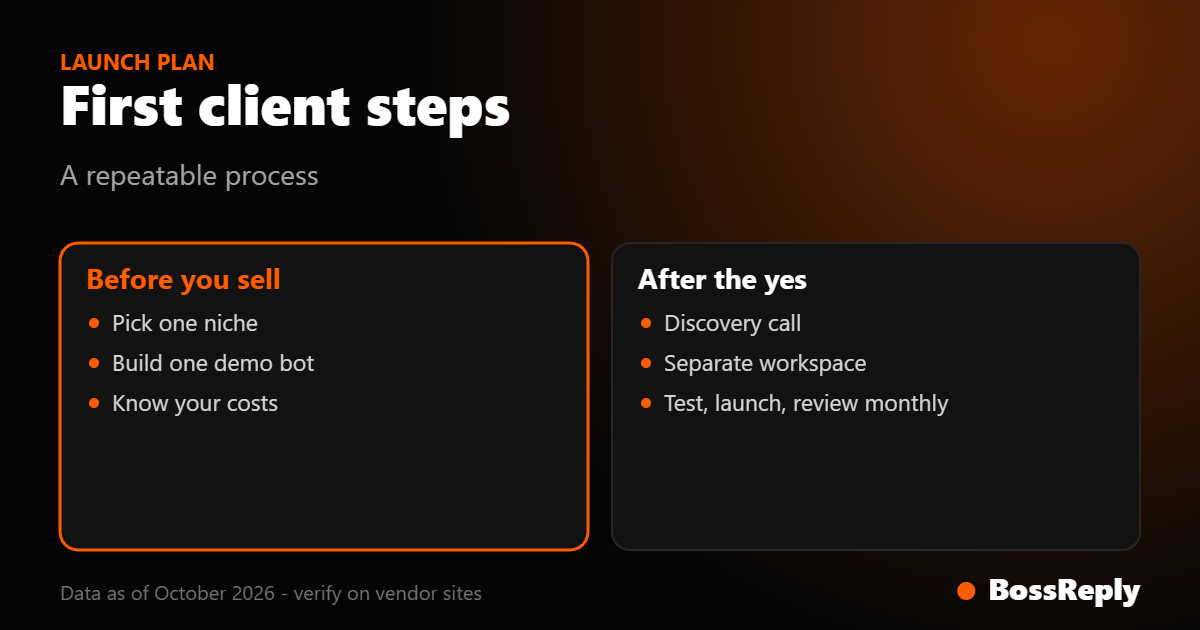
Work from one repeatable process so the second client takes a fraction of the time of the first. A process we suggest:
Discovery call (30 minutes): list the 20 questions they answer most; identify the channels; agree what the bot must never do.
Collect content: prices, policies, FAQs, tone examples. Ask for it in a shared document.
Build: create a separate workspace for the client, load the knowledge base, set the handover rule.
Test: have the client try to break it with ten awkward questions.
Launch on one channel first, then add others after a week of review.
Review monthly: read the conversations the bot could not answer and add those answers.
Keep each client in its own workspace, with its own keys if the client pays for AI usage, so one client's problem never touches another's. See our chatbot security checklist for access rules.
How do you find your first clients?
Start with people who already trust you. Previous employers, past customers, or owners in a niche you know are warmer than cold outreach. A few practical approaches:
Build a demo bot for a business like theirs and send a short screen recording or a link, rather than a long proposal.
Offer a small paid pilot (for example, one channel for one month) with a clear success measure the client chooses, such as response time.
Test your own pitch: if you contact a business on Instagram, write each message by hand and keep it relevant; do not mass-message strangers.
Ask for a testimonial only after real results; never invent one.
We cannot give a typical close rate or time to first client because we did not find reliable published data, and you should be sceptical of numbers that sound too tidy.
What should be in your contract?
Put the scope, the fees, who owns the accounts, and who pays platform and message costs in writing. Items to cover, which are general suggestions rather than legal advice:
What is included in setup and in monthly management, and what costs extra.
Who owns the channel accounts and the content, and what happens if the client leaves.
Who pays for AI usage and Meta message fees, and any monthly cap.
How personal data is handled; if clients are in the EU or UK, get advice on data processing agreements.
Notice period and what you do not promise, such as specific sales results.
Common mistakes new agencies make
Choosing a tool on price alone, then discovering per-client or per-message fees that erase the margin.
Promising "white label" to clients without confirming what the platform really allows.
Building a fancy bot before getting a single yes.
Leaving the client's AI key or account logins in shared chat messages or spreadsheets.
Selling "set and forget" when the bot needs updating as prices and policies change.
Frequently asked questions
Do I need to code to start a chatbot agency?
No. Modern platforms use visual builders and knowledge bases. Basic writing, process discipline and communication matter more than programming.
How much does it cost to start?
Platform fees range from $69 per month on BossReply Agency to $497 on GoHighLevel Agency Pro, per the vendors' pages in October 2026. Add AI usage and any WhatsApp message fees.
Do I need white label?
Only if you want clients to see your brand instead of the vendor's. Many agencies start without it. Confirm exactly what each vendor's white label includes.
Which channels should I offer first?
The ones your niche already uses. For many service businesses that is Instagram DMs and WhatsApp. BossReply also covers Messenger, Telegram and website chat in one inbox.
Should clients bring their own AI key?
It keeps usage costs transparent and under the client's control. Follow the provider's key safety guidance, as covered in our key setup and safety guide.
How many clients can one person manage?
We could not find reliable data. It depends on how much conversation review each client needs; start with a few and measure your own time.
Can I use the same bot for multiple clients?
Reuse the structure, not the content. Each client needs its own knowledge base, workspace and handover rules.
Sources and method
Pages read in October 2026; confirm prices on the live pages.
Vendor pricing pages for Stammer.ai, FastBots, GoHighLevel, DM Champ and ChatLab, read October 17, 2026: plan names and monthly prices. Some vendor pages did not state client or sub-account limits, so we do not either.
Model provider pricing pages (OpenAI developers pricing, Anthropic pricing documentation, Google Gemini API pricing), read October 2026: per-million-token prices. Conversation costs are our own arithmetic.
Meta for Developers, WhatsApp Business Platform pricing, read October 2026: per-message template pricing and the 24-hour customer service window.
BossReply plan facts from our own product information. Process steps, niche advice and pitch ideas are our suggestions, not market statistics.
Conclusion
A chatbot agency is a service business with software behind it: pick a niche, price your tools honestly, run a repeatable setup and sell a small pilot first. If you want to test the workflow with your first client workspace, you can start at chat.bossreply.com.