WhatsApp Business API Pricing in 2026: What You Really Pay
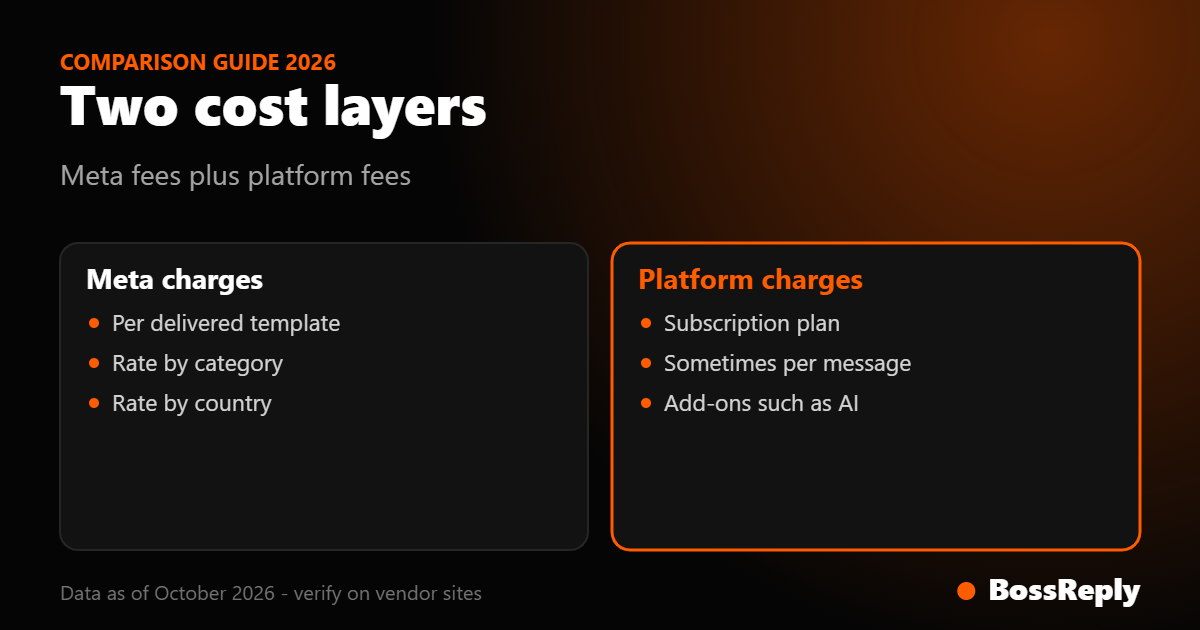
Short answer: WhatsApp Business API pricing has two layers. Meta charges per delivered template message, with the rate set by template category and the recipient's country. Your platform then charges its own subscription, and sometimes a per-message fee on top. Vendors have announced that replies inside the 24-hour window become billable from October 1, 2026; Meta's page did not confirm this when we read it.
Last updated: October 17, 2026. Written by the BossReply Team. BossReply is our product and is mentioned where relevant; prices change often, so confirm every figure on the official pages listed at the end.
Key takeaways
Since July 1, 2025, Meta bills per delivered template message instead of per 24-hour conversation. Marketing templates are always charged.
Your real cost is Meta's fee plus your provider's fee. Providers differ: some add nothing, some add a per-message charge, and some include credit in the plan.
Several providers say service messages (non-template replies in the 24-hour window) become billable from October 1, 2026, with a monthly free allowance. We could not confirm this on Meta's own page.
Always price your plan at your real monthly volume, split by category and country, before comparing vendors.
How does WhatsApp Business API pricing work in 2026?
Meta charges for each template message that is delivered. According to Meta's pricing page, the amount depends on the template category and the recipient's country calling code, and you are charged only when a template message is delivered. This replaced conversation-based pricing on July 1, 2025.
Meta lists three template categories: marketing, utility and authentication. Businesses are responsible for checking the category on each approved template, because they accept the charge for the category applied at the time of use. Our template guide explains how categories are decided.
What is free and what is charged?
Message type | Charged by Meta? | Note |
|---|---|---|
Marketing template | Yes | Always charged, rate depends on country |
Utility template, outside a service window | Yes | Rate depends on country; volume tiers can lower it |
Utility template, inside an open service window | Free on Meta's page when we read it | Vendors announce a change from October 1, 2026 |
Authentication template | Yes | Volume tiers can lower the rate |
Non-template reply inside the 24-hour window | Free on Meta's page when we read it | Vendors announce a change from October 1, 2026 |
Messages a customer sends you | No | Reported by vendors |
Any message in a free entry point window | Free for 72 hours | After a click-to-WhatsApp ad or Page button, if you reply within 24 hours |
What is changing on October 1, 2026?
Meta's pricing page lists October 1, 2026 as a rate-change date for specific markets: lower utility and authentication rates in Bangladesh, Iraq, Nepal and Sri Lanka, and higher utility and authentication rates in Kazakhstan, Kuwait, Morocco, Oman and Ukraine, plus a new authentication-international rate. The page also says pricing updates occur only on the first day of a quarter, with at least one month's notice for rate card changes.
Separately, WATI, Gupshup and Zoho have published notices saying that from October 1, 2026, service messages become billable per message, priced like a utility template in the customer's country, with 1,000 free service messages a month per number. Other vendor blogs repeat this and some give different details about the allowance. Meta's pricing page, which we fetched on October 17, 2026, says non-template messages within an open customer service window are free and does not mention a 1,000-message allowance.
That conflict matters to your budget. Until Meta's page and your provider agree, assume service replies may cost money, and ask your provider for its written rate card. Also note that a pricing page can lag an announcement, so check for updates before each quarter starts.
What do platforms add on top of Meta's fees?
Most platforms charge a subscription, and some also charge per message. The table shows published figures we read in October 2026. These are the vendors' own prices or reported figures, and several pages gave incomplete or conflicting numbers, which we flag.
Provider | Pricing model | Published figure | Meta fees |
|---|---|---|---|
BossReply | Flat plans, not priced by stored contacts | $14, $29 or $69 per month | Billed separately by Meta when you use the official API |
respond.io | Per monthly active contact | Starter $79/month (page structured data shows $99, a conflict) | Not included; top up credit |
Zoko | Plan plus per-conversation fee | $49.99 to $499.99/month; fee from $0.015 to none depending on plan | Paid to Meta at the rate card |
Kommo | Per user, 6-month minimum | From $25 per user per month | Not stated on page |
Twilio | Per message | $0.005 per message in or out | Passed through on top |
Gupshup | Per message | $0.001 per template or session message | Billed at actuals |
WATI | Per plan, user and message | Base price not verified on its page | "Based on WATI rate card"; markup not stated |
We could not verify whether WATI adds a markup to Meta's rates. Competitor sites claim a figure, but WATI's page does not state one, so we leave it out. Our WATI vs respond.io vs BossReply comparison covers the differences in more detail.
How do you estimate your monthly bill?
Add the platform subscription to Meta's fee for each message type you expect to send. This is a method you can run in a spreadsheet in ten minutes.
Count conversations you start. How many marketing, utility and authentication templates will you send per month, and to which countries?
Look up Meta's rate card. Find the per-message rate for each country and category on Meta's pricing page, in the currency you are billed in.
Add the service message question. Estimate how many replies you send inside 24-hour windows. If your provider confirms service messages are billable, price them like utility templates and subtract any free allowance.
Add provider fees. Include any per-message or per-conversation platform fee, per-user charges and add-ons such as AI credits.
Add a buffer. Add 20 to 30 percent for campaigns you have not planned yet. That is a planning habit, not a figure from Meta.
A worked example, clearly illustrative
For example, suppose a clinic sends 1,000 appointment reminders (utility) and 500 promotional messages (marketing) a month to one country. Take the country's utility rate from Meta's rate card, multiply by 1,000, take the marketing rate and multiply by 500, then add the platform plan. The numbers depend entirely on your country's rates, so we do not print dollar amounts here. The point is that marketing messages usually cost more than utility messages, so changing what you send changes the bill.
What can lower your WhatsApp costs?
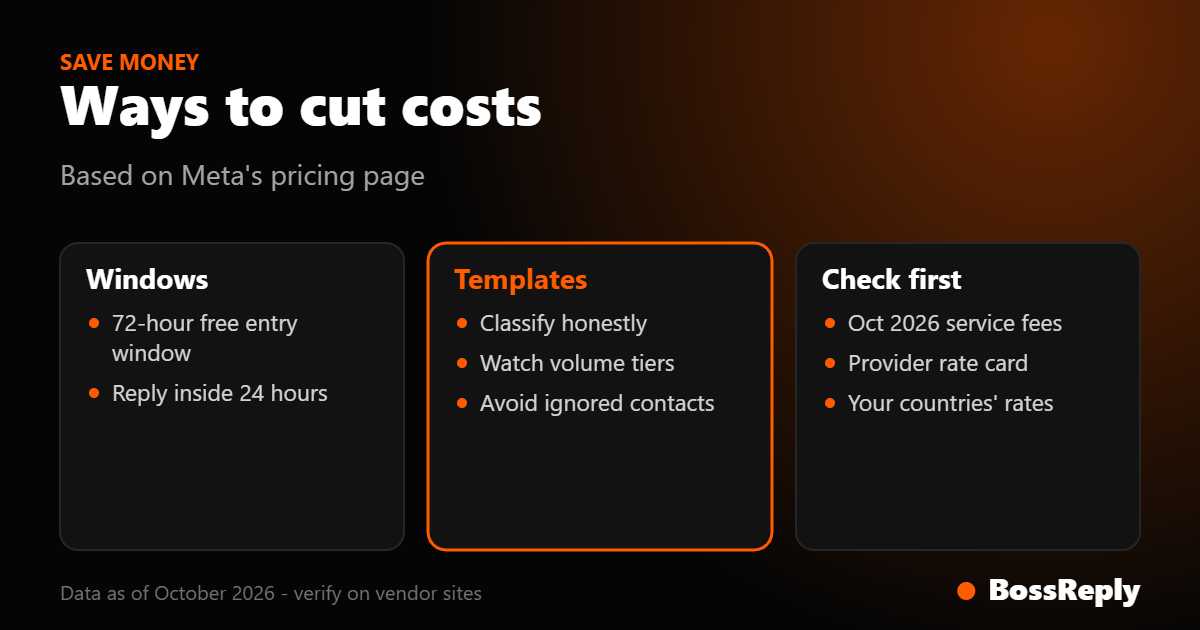
Use free entry points. Meta says that when a customer messages you through a click-to-WhatsApp ad or a Page call-to-action button and you reply within 24 hours, all messages, including templates, are free for 72 hours.
Keep conversations in the service window. Replying within 24 hours of a customer message avoids template charges, subject to the October 2026 question above.
Classify templates correctly. A genuine utility template costs less than marketing, but Meta can reclassify a template as marketing if it contains promotion. Misclassifying repeatedly can lead to restrictions.
Watch volume tiers. Meta says volume tiers lower utility and authentication rates and are tracked per market and category, resetting monthly.
Avoid sending to people who ignore you. Messages that get blocked or reported hurt quality and can limit sending.
Does the QR route avoid Meta's fees?
QR-linked tools work like WhatsApp Web, so they do not use Meta's template billing. They sit outside the official platform, though. WhatsApp's business policy says it may take action against messaging people at scale in an unauthorized manner, and ban reports come from vendors rather than from Meta. Saving on fees is not a good reason to risk your main business number. The trade-offs are covered in WhatsApp QR vs Business API.
BossReply connects WhatsApp by QR login or through the official Business API. See the WhatsApp chatbot page and the pricing page for plan limits.
Frequently asked questions
Is the WhatsApp Business API free?
The API itself is not free for business messaging. Meta charges for delivered template messages, though non-template replies in an open window were free on its page when we read it. Platforms add their own fees.
How much does a WhatsApp message cost?
It depends on the template category and the recipient's country. Meta publishes rate cards by country, and we do not quote a single figure because the range is wide.
Do I pay when a customer messages me first?
Messages from customers are not charged, according to vendor pages. Your replies in the 24-hour window were free on Meta's page when we read it, with a vendor-announced change from October 1, 2026.
What are WhatsApp volume tiers?
Meta says tiers lower utility and authentication rates based on monthly volume, tracked per market and category. Marketing is not mentioned as discounted on the page we read.
Why does the same message cost different amounts in different countries?
Meta sets rates by the recipient's country calling code. Check the card for each country you message.
Do providers mark up Meta's prices?
Some do, some do not. Gupshup states fees billed at actuals, and Zoko says Meta fees are paid at Meta's rate card plus its own fee. Ask each vendor for its policy in writing.
Can I pay Meta in my local currency?
Meta's page lists 16 currencies, including USD, EUR, GBP, INR and BRL, with some migration dates for India and Brazil. Check which applies to your account.
Sources and method
We read these pages in October 2026. Prices change, so confirm on the official page before you buy.
Meta for Developers, WhatsApp pricing: per delivered template billing, categories, service window, free entry point window, volume tiers, the October 1, 2026 country changes, and currencies. Read October 17, 2026.
WATI support article on pricing changes, Gupshup pricing page and a Zoho community notice: the vendor announcement of billable service messages from October 1, 2026. Read October 2026.
respond.io, Zoko, Kommo, Twilio and WATI pricing pages: the published figures in the table. Read October 17, 2026; several pages were truncated or inconsistent.
What we could not verify: Meta's own confirmation of billable service messages, the 1,000 free allowance, WATI's base prices, and Zoko's agent counts on the top plan.
Conclusion
The honest answer to "what will it cost" is a small spreadsheet: Meta's per-message rates for your countries and categories, plus your platform fee, plus a buffer. Confirm the October 2026 service message question with your provider before you sign anything. If you prefer flat plans that are not priced by stored contacts, take a look at chat.bossreply.com.