ManyChat vs Chatfuel (2026): Pricing, AI and Channels Compared
Short answer: choose ManyChat if you want the best-known flow builder for Instagram and Messenger and your active-contact count stays small. Choose Chatfuel if you want unlimited contacts and messages on a flat plan with an AI credit allowance and a wide channel list (WhatsApp, Instagram, Messenger, TikTok and website chat). If you want a third option with a choice of AI model, bring-your-own-key and flat plans, look at BossReply.
Last updated: October 17, 2026. Written by the BossReply Team. BossReply competes with both tools, so we label every third-party figure and mark what we could not verify. Neither ManyChat's nor Chatfuel's own pricing page was reachable by our tools.
Key takeaways
ManyChat charges per active contact, with tiers reported from $0 to $139 per month. Chatfuel is reported at $20 per month for a single business with unlimited contacts and an AI credit allowance.
Chatfuel's limit is its AI allowance: when it runs out, the bot pauses unless you connect your own OpenAI key, according to a competitor-written review.
Both support WhatsApp and Instagram, but we could not verify the WhatsApp connection type for either.
Pricing data for both comes from third parties and should be checked on the live pages.
ManyChat vs Chatfuel at a glance
Feature | ManyChat | Chatfuel |
|---|---|---|
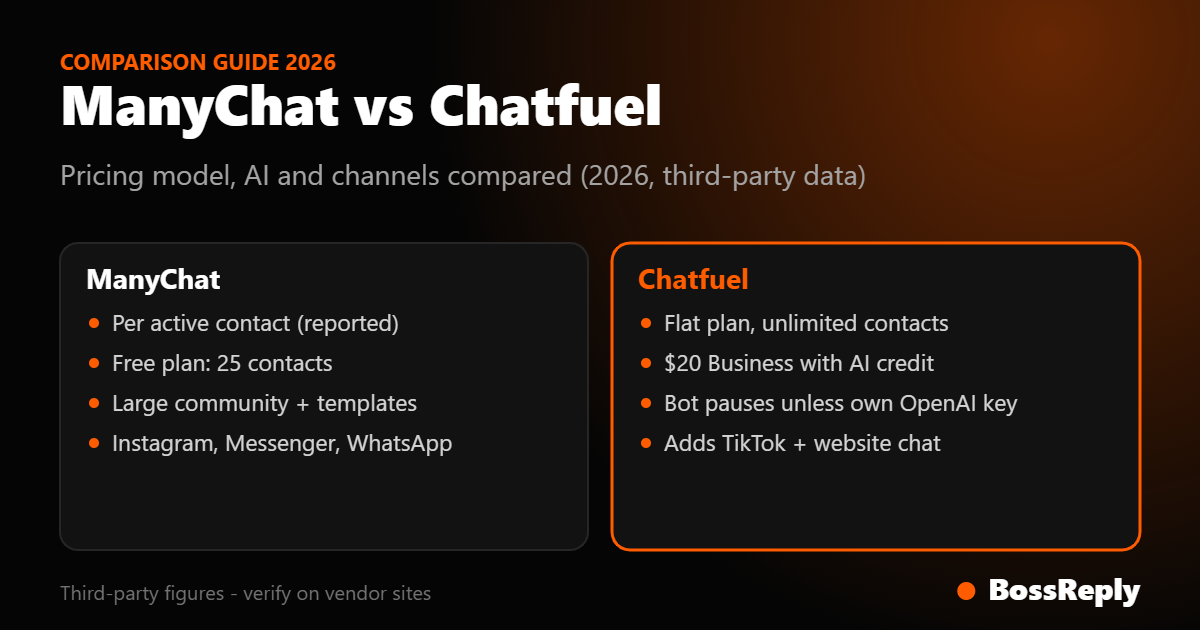
Pricing model | Per active contact | Flat plan with AI credit allowance |
Entry price (reported) | Free for 25 contacts, Essential $14 for 250 | Business $20/month ($18 yearly) |
Contacts and messages | Limited by tier, overage fees | Unlimited, AI fair-use |
AI | Bundled from Pro or add-on (sources conflict) | AI credit included ($20 on Business) |
Bring your own AI key | Not verified | Reported, using an OpenAI key |
Channels | Instagram, Messenger, WhatsApp (Pro and up, reported) | WhatsApp, Instagram, Messenger, TikTok, website |
Agency option | Affiliate and directory program | Agency S: $100/month, up to 3 client businesses |
Free plan | Yes (25 contacts, reported) | No free plan, free trial reported |
How does pricing compare?
ManyChat
A guide from eesel.ai edited on September 28, 2026 reports annual-equivalent prices of $14 (Essential, 250 contacts), $29 (Pro, 2,500), $69 (Business, 7,500) and $139 (Advanced, 25,000), plus a free plan. Overage fees apply per contact past your tier, from $0.10 on Essential down to $0.004 on Advanced. Our ManyChat pricing explained guide works through examples.
Chatfuel
A review published by SetSmart, a competitor, reports two plans checked on October 16, 2026: Business at $20 per month ($18 on yearly billing) including $20 of AI credit and one business, and Agency S at $100 per month ($90 yearly) including $100 of AI credit and up to 3 client businesses. Contacts and messages are unlimited, and the limit is the AI allowance. Other sources show older or different plans, so treat the numbers as indicative.
What this means
If you have thousands of contacts but few AI conversations, Chatfuel's model can cost less than ManyChat's per-contact tiers. If you have a small audience and want a free start, ManyChat's free plan is the easier entry. If AI is the main cost, check how many AI replies the credit covers, because heavy AI use can exhaust the allowance within the month.
A worked example
Take a coach with 5,000 people who message in a month. On ManyChat's reported tiers, Pro covers 2,500 contacts at $29, and the extra 2,500 at $0.05 each add $125, about $154 in total, while Business at $69 covers 7,500 and is the cheaper choice. On Chatfuel's reported Business plan the contact count does not change the $20 price, but the $20 AI credit has to cover every AI reply. If 5,000 people each trigger an AI conversation costing a few cents, the allowance can run out within the month and the bot pauses unless you connect your own OpenAI key. The honest comparison is therefore your monthly contacts against your monthly AI replies, not the headline prices.
Which has better automation?
ManyChat is built around flows, with triggers for comments, story replies and keywords, and a large library of templates and community content. Chatfuel also builds flows and comment replies, and it highlights AI agents that answer from your content. Both can send a DM when someone comments a keyword on Instagram. Meta's rules apply to both: a private reply to a comment must be sent within 7 days, only one message can go to each commenter until they reply, and the 24-hour window applies after that.
The practical difference is the starting point. ManyChat starts from the flow and has years of community examples. Chatfuel starts from the AI agent plus flows. Test your own most common flow on each, because quality depends on how you build it.
Which has better AI?
Chatfuel includes an AI credit with each plan, and the bot pauses when the credit is used unless you connect your own OpenAI key. ManyChat's AI answers from a pasted knowledge library reported at up to 250,000 characters, and sources disagree on whether it is bundled or an add-on. We could not verify which models either tool uses beyond Chatfuel's OpenAI key option.
Which has better channels?
Chatfuel lists WhatsApp, Instagram (DMs and comment replies), Messenger, TikTok and website chat. ManyChat is known for Instagram and Messenger, with WhatsApp reported from the Pro plan upward. For both, WhatsApp template fees are charged by Meta on top of the subscription, and we could not verify whether either supports a QR connection or only the official API. If WhatsApp matters, read WhatsApp QR vs Business API first.
What about agencies?
Chatfuel's Agency S plan covers up to 3 client businesses for $100 per month, which makes it simple to quote, although we could not verify true white-label features. ManyChat's partner page offers an affiliate and agency directory, and we found no reseller or white-label plan. Agencies that want white label and many clients should also look at DM Champ and BossReply in our white-label platform comparison.
What do users say?
ManyChat reportedly holds 4.5 out of 5 on G2 (165 reviews), 4.6 out of 5 on Capterra (72) and 2.1 out of 5 on Trustpilot (303), where reviewers mention billing surprises and cancellation. We did not gather review scores for Chatfuel, so we make no claim about its reputation. Read recent reviews of both before buying.
Who should choose which?
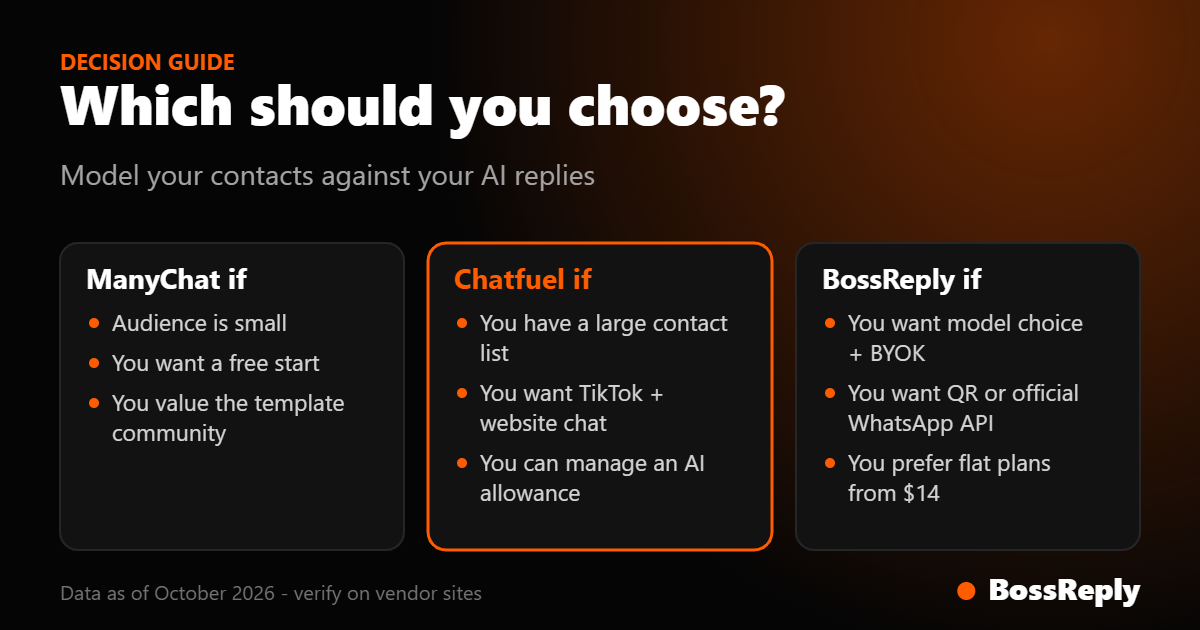
Choose ManyChat if…
You want the largest community and template ecosystem for Instagram and Messenger.
Your active contacts stay under a few hundred, or you can model the cost of the next tier.
You want to start on a free plan.
Choose Chatfuel if…
You have a large contact list and want unlimited contacts and messages.
You want TikTok and website chat alongside WhatsApp and Instagram.
You are comfortable managing an AI credit allowance or connecting your own OpenAI key.
Consider BossReply if…
You want to choose your AI model (OpenAI, Claude, Gemini or Grok) and bring your own key.
You want WhatsApp by QR or the official API, Instagram, Messenger, Telegram and website chat in one shared inbox.
You prefer flat plans at $14, $29 and $69 per month. See the BossReply vs ManyChat comparison.
How do you test both fairly?
Choose one workflow, for example "comment GUIDE, receive a link and a qualifying question".
Build it in both tools and time how long it takes.
Send ten real customer questions to each AI and compare the answers.
Record the cost at your expected contacts and at ten times that volume.
Check cancellation and data export before you pay for a year.
What are the risks of switching later?
Whichever you pick, you will build flows, tags and contact lists inside the tool. Moving them later means rebuilding automations by hand, and we do not claim any automatic import between ManyChat, Chatfuel and BossReply. Reduce the risk by keeping your lead magnets, keywords and message copy in a separate document, exporting contacts regularly if the tool allows it, and starting with the one or two flows that earn money rather than rebuilding everything at once.
Frequently asked questions
Is Chatfuel better than ManyChat?
Neither is better for everyone. Chatfuel suits large contact lists and a broader channel list, while ManyChat has the larger community and a free plan.
Which is cheaper, ManyChat or Chatfuel?
For small audiences ManyChat's free and $14 tiers are cheaper. For many contacts with limited AI use, Chatfuel's flat $20 plan can cost less. Check both live pricing pages.
Does Chatfuel have a free plan?
A competitor review reports no free plan and a free trial. Confirm on chatfuel.com.
Does ManyChat support WhatsApp?
Reportedly from the Pro plan, with Meta's fees on top.
Can I bring my own AI key to Chatfuel?
The same competitor review says yes, using an OpenAI key. For BossReply you can bring your own key too.
What is a good alternative to both?
BossReply, DM Champ, Inrō and ReplyRush are options. See the ManyChat alternatives roundup.
Do the prices change?
Yes. Confirm each price on the vendor's website.
Sources and method
We compared pricing model, AI, channels and fit. ManyChat figures come from eesel.ai (edited September 28, 2026). Chatfuel figures come from a SetSmart review checked October 16, 2026, which is written by a competitor, and from costbench.com changelog notes. Meta's rules come from developers.facebook.com. BossReply details come from bossreply.com/pricing. Neither vendor's own pricing page was reachable, so figures are labelled as reported.
Conclusion
ManyChat and Chatfuel suit different audiences: ManyChat for small, flow-driven Instagram setups, Chatfuel for larger lists with managed AI use. Before committing, build one real flow in each and compare the bill at your volume. Try BossReply as a third option, or visit the ManyChat alternative page.